

Ask questions grounded in uploaded documents.
DocTree vs RemNote
RemNote combines linked notes, flashcards, spaced repetition, and exam planning. DocTree is for learners who want to investigate trusted sources, see how ideas connect, and preserve useful answers on a visual canvas.
Both products help learners build knowledge, but they emphasize different learning loops.
RemNote connects notes and flashcards, schedules review with spaced repetition, and offers exam-focused planning, PDF annotation, offline access, and collaboration features.
DocTree connects selected sources, contextual questions, explanations, and generated artifacts on a spatial canvas designed for continued exploration and reuse.
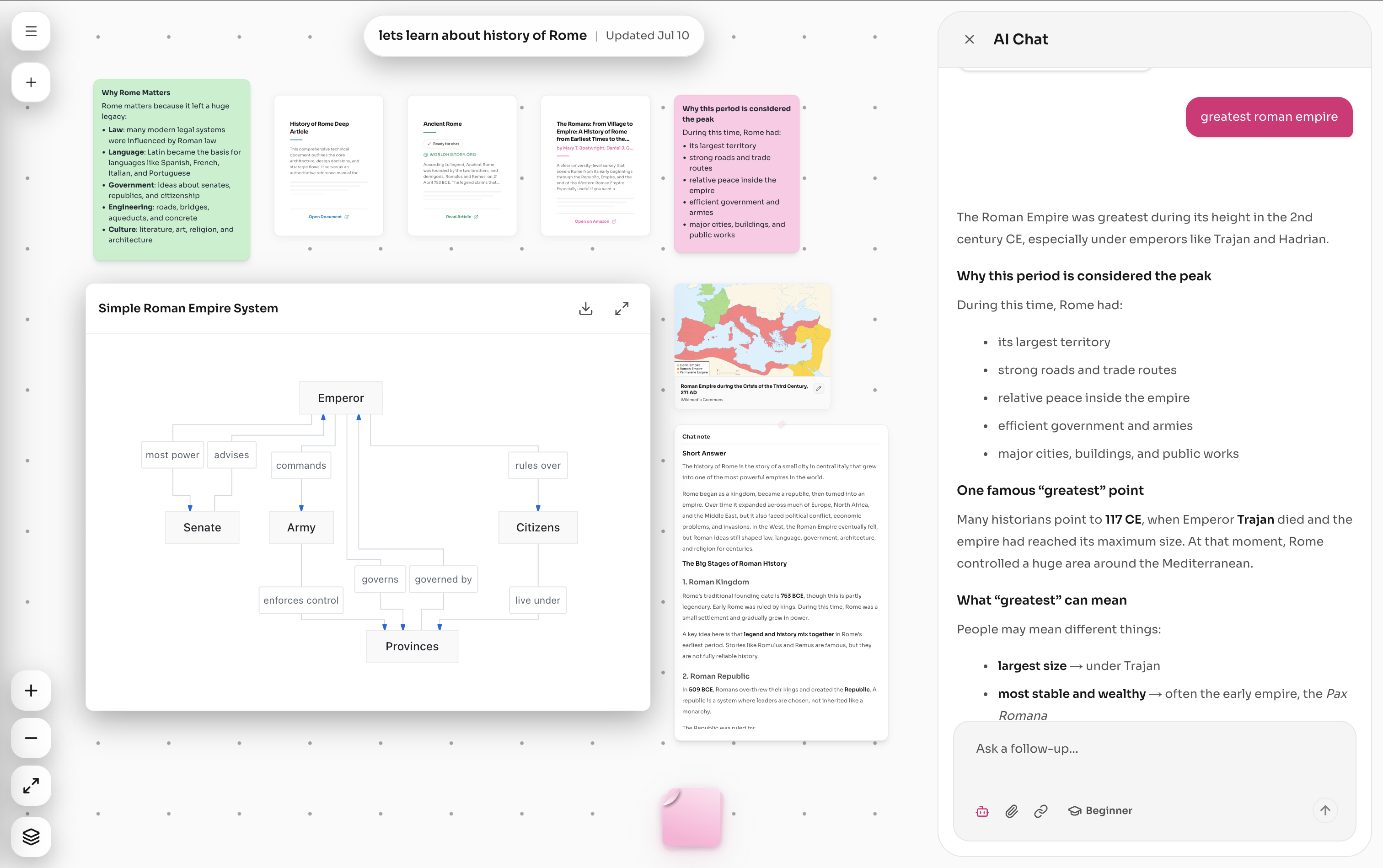
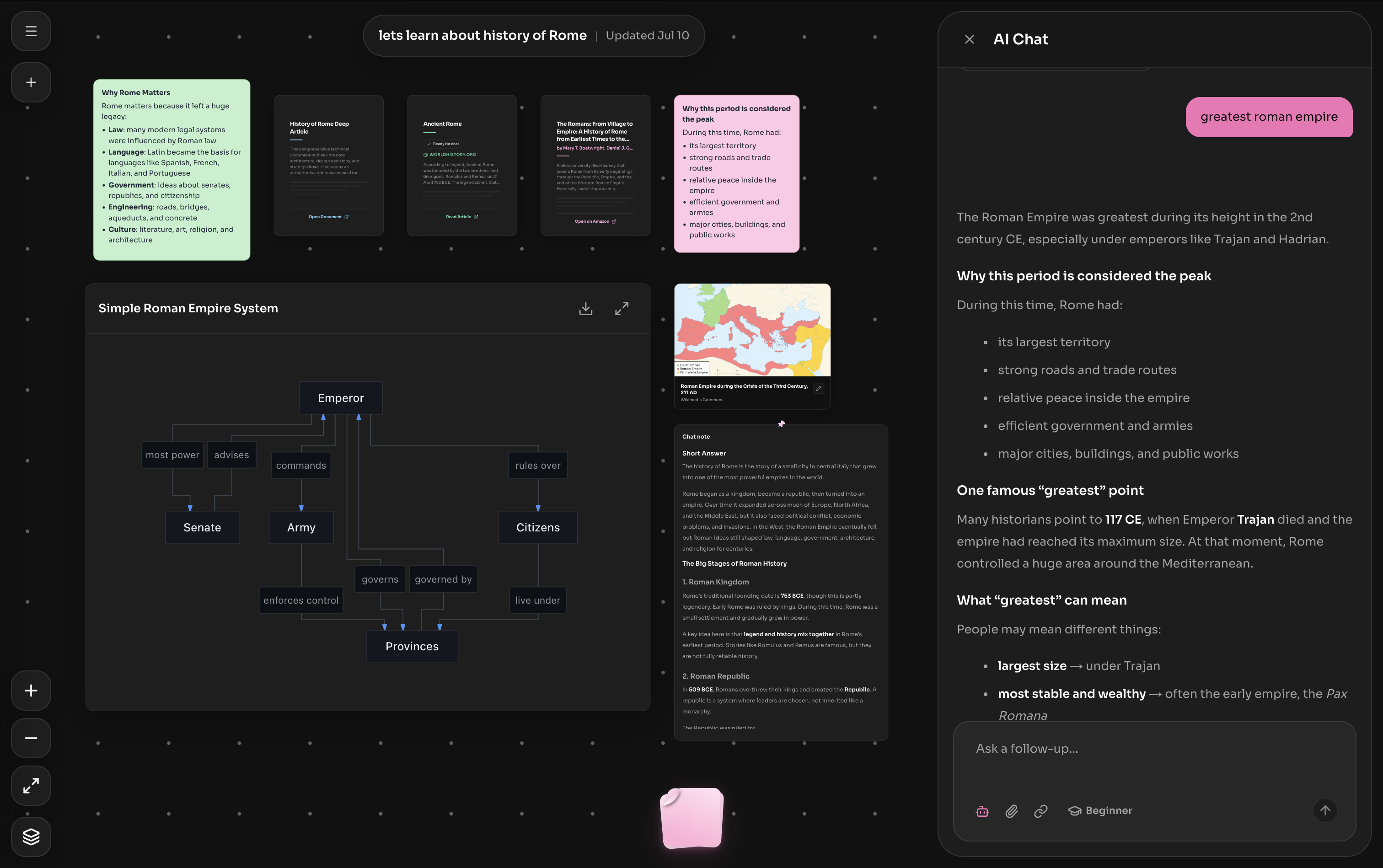
Choose RemNote for linked notes and scheduled recall. Choose DocTree when you want to explore mixed sources and build a visual, reusable understanding of a subject.
RemNote Notes & Spaced Repetition | DocTree Agentic Learning Workspace | |
|---|---|---|
| Connect notes and concepts | IncludedLinked references and a knowledge-base hierarchy connect notes and concepts | IncludedSpatially connects compatible sources, questions, and artifacts on a canvas |
| Create native flashcards | IncludedTurns notes into several native flashcard types | Not includedDoes not provide a native flashcard drill workflow |
| Schedule spaced-repetition reviews | IncludedSchedules cards with spaced repetition and adjustable settings | Not includedFocuses on investigation and knowledge creation rather than review scheduling |
| Plan for an exam | IncludedExam Scheduler adapts review to a target date | Not includedBuilds an ordered curriculum, not an exam review schedule |
| Learn from PDFs and files | IncludedReader supports PDF annotation, references, and flashcards | IncludedExtracts and retrieves relevant passages from selected compatible sources |
| Ask source-aware questions | IncludedAI features help explain documents and generate study material | IncludedUses explicitly selected canvas context for grounded questions and transformations |
| Organize knowledge spatially | Not includedOrganizes knowledge through documents, folders, links, and references | IncludedLets you move, resize, connect, and arrange compatible items on a freeform canvas |
| Adapt explanation depth | IncludedAdapts review timing and offers AI-assisted study tools | IncludedApplies beginner, familiar, or expert depth across answers and artifacts |
| Generate learning artifacts | IncludedGenerates flashcards and assists with notes and document study | IncludedCreates summaries, deep articles, diagrams, mind maps, notes, code, and resources |
| Build an ordered curriculum | Not includedUses documents and outlines rather than a curriculum-to-article workflow | IncludedBuilds a sequenced curriculum whose topics can open into deeper content |
| Work offline | IncludedSupports offline use with local data and later synchronization | Not includedRequires the online workspace for its current learning workflow |
| Import or export knowledge | IncludedSupports importing notes and exporting knowledge in documented formats | Not includedAccepts compatible source formats but does not directly import a RemNote knowledge base |
| Share and collaborate | IncludedSupports sharing, knowledge-base collaboration, and shared flashcards | Not includedDesigned primarily as an individual knowledge-building workspace |
See how DocTree turns a topic into an explorable curriculum and keeps it on a visual workspace for continued learning.
Generate quizzes, flashcards, summaries, and notes from the topic you are already learning.
Keep practice attached to the exact node, source, or branch where the idea belongs.
Move from video, tree, notes, and practice without rebuilding decks or switching tools.
DocTree Advantage
DocTree keeps sources, questions, explanations, diagrams, and curriculum together so you can investigate how ideas fit.
DocTree Advantage
Arrange compatible sources and artifacts on a canvas that makes clusters, gaps, and connections easier to revisit.
DocTree Advantage
Keep compatible artifacts on the canvas, select the ones that matter, and use them for the next explanation or transformation.
The right product depends on whether your main loop is scheduled recall or source-grounded visual exploration.
Simple verdict
Choose RemNote for linked notes, flashcards, spaced repetition, exam scheduling, offline study, and collaboration. Choose DocTree for visual synthesis across mixed sources and reusable AI learning artifacts. They can also work together.
RemNote
DocTree
Traditional flashcards
Source-grounded learning workspace
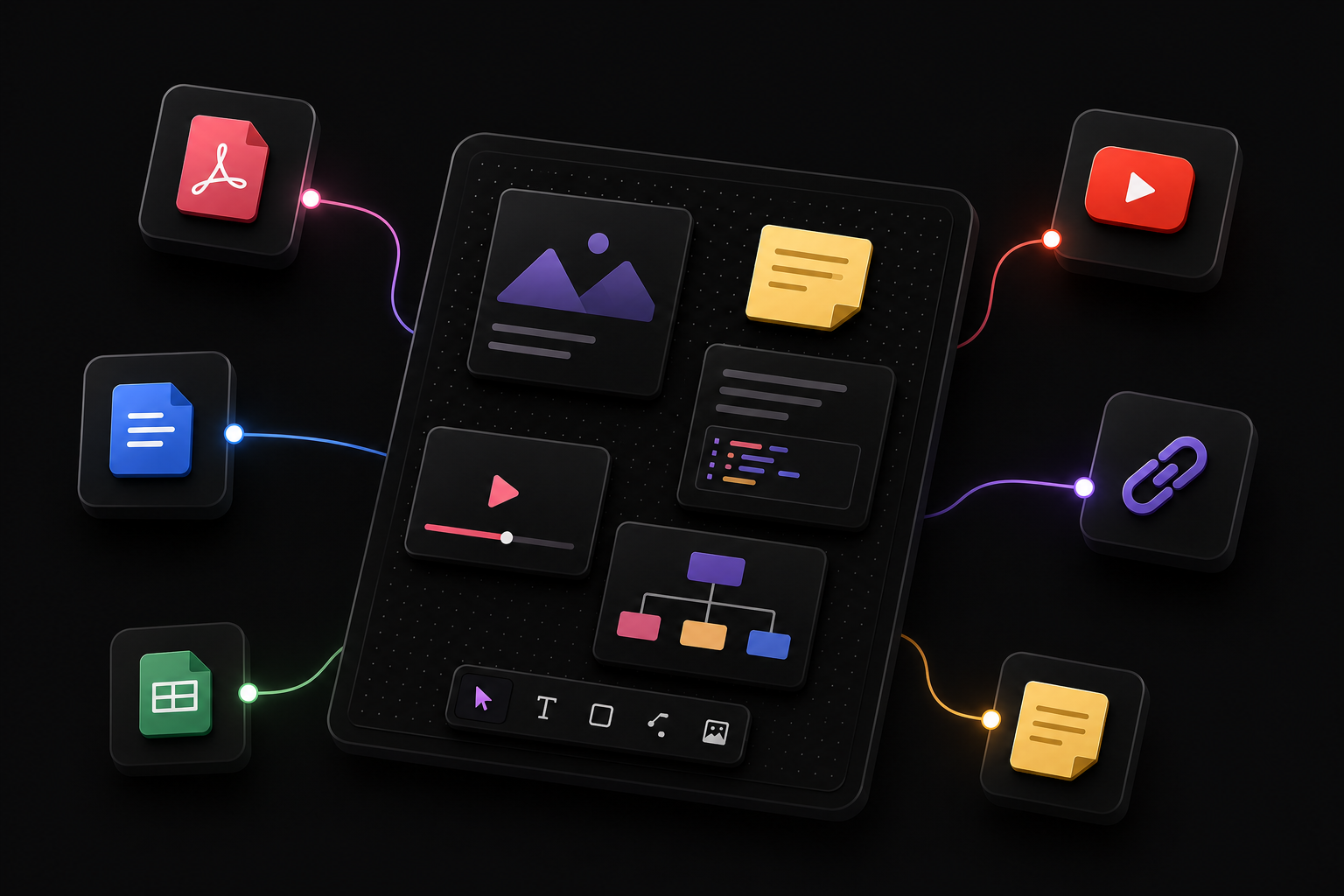
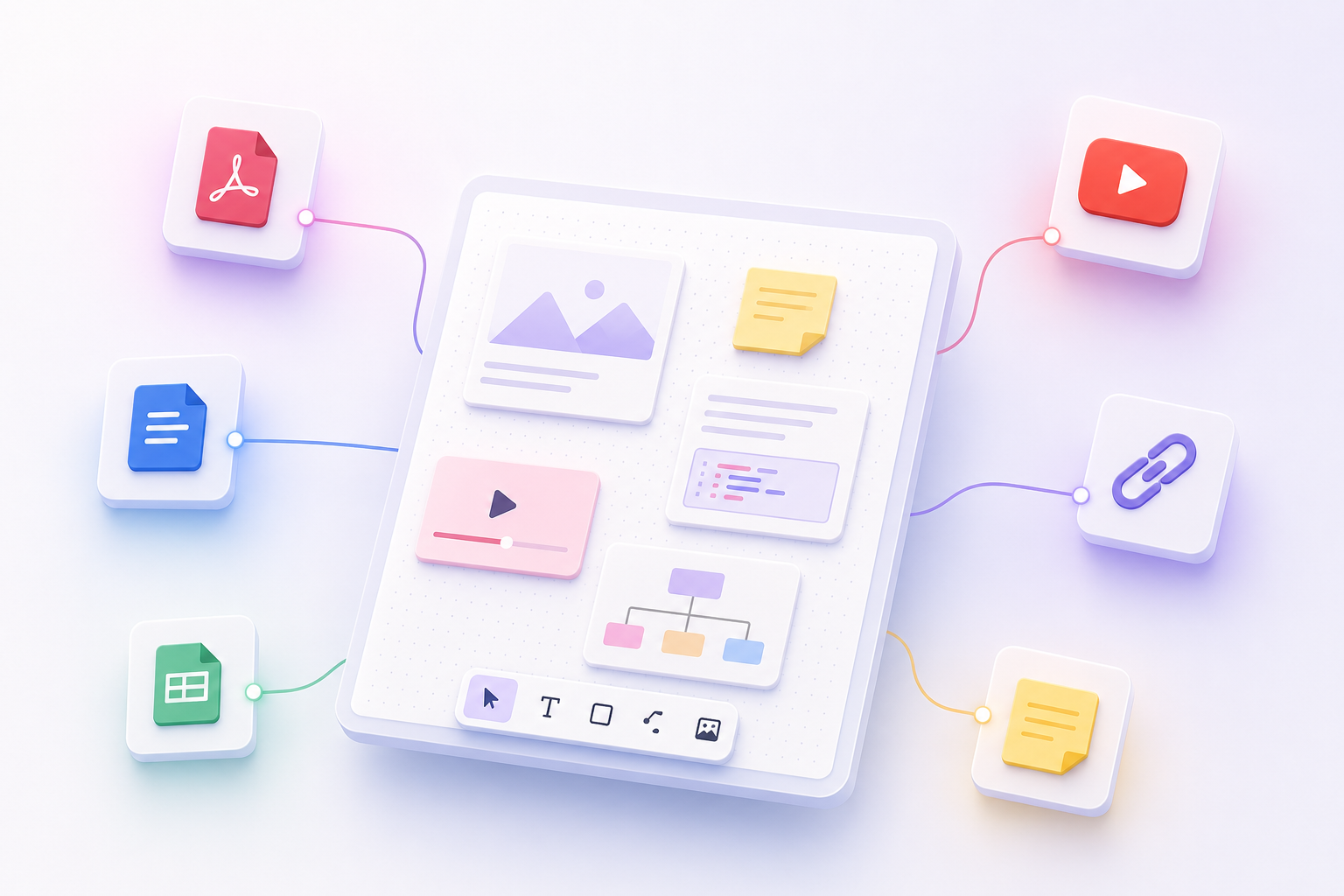
Add PDFs, text documents, articles, YouTube videos, links, and notes to one canvas. Keep the evidence behind your learning close at hand.
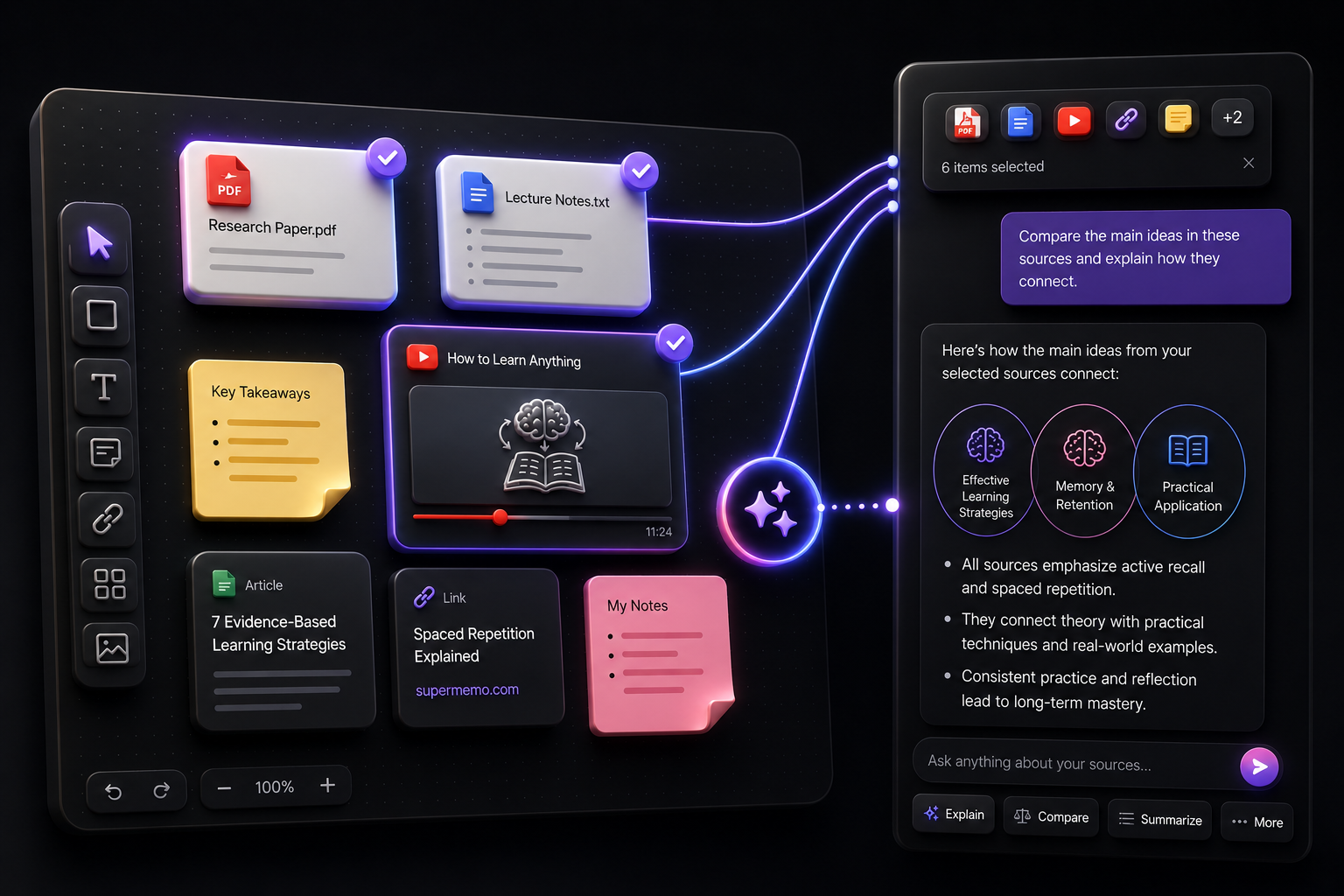
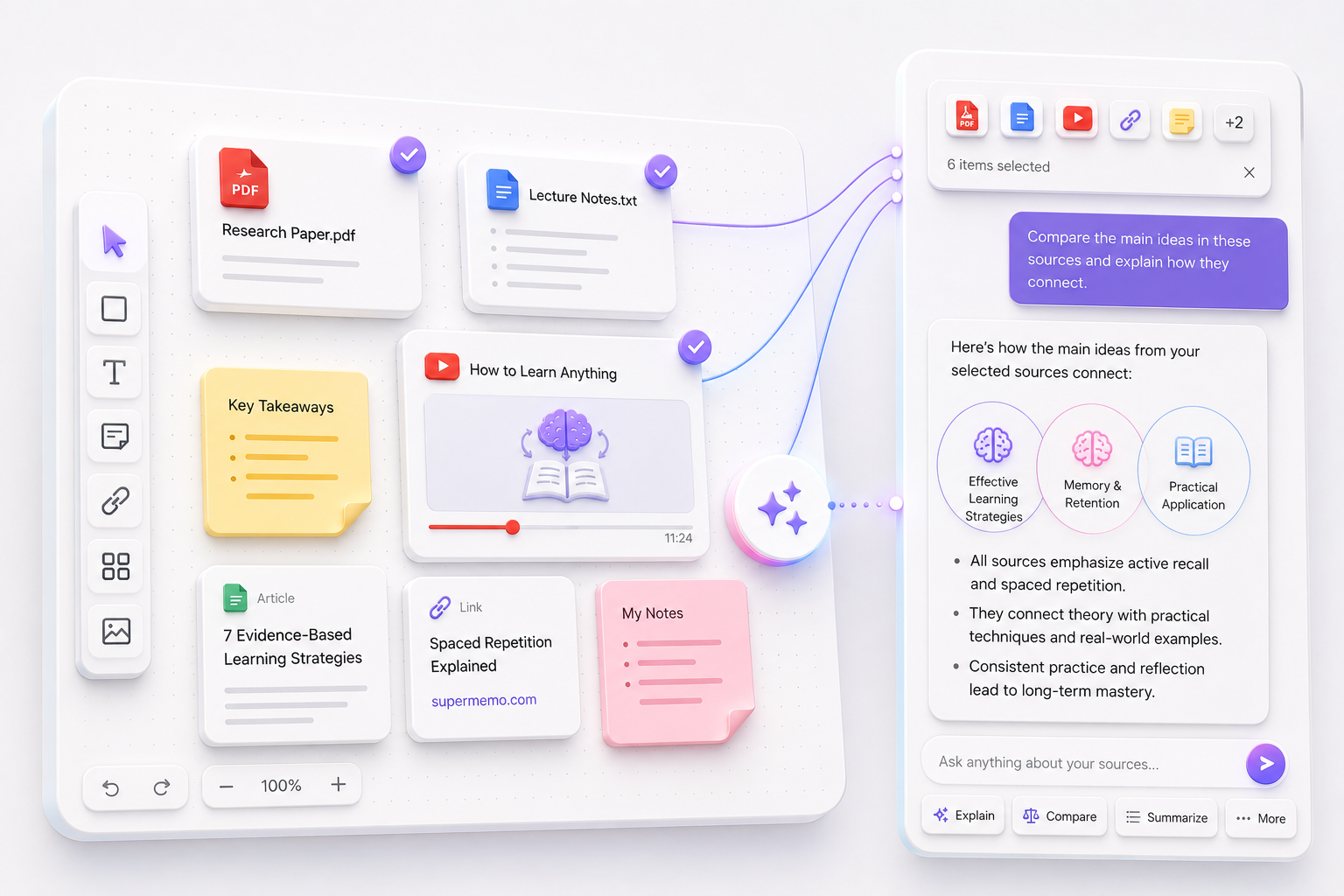
Select the exact compatible sources or artifacts you want to discuss, then ask DocTree to explain, compare, summarize, transform, or expand them.
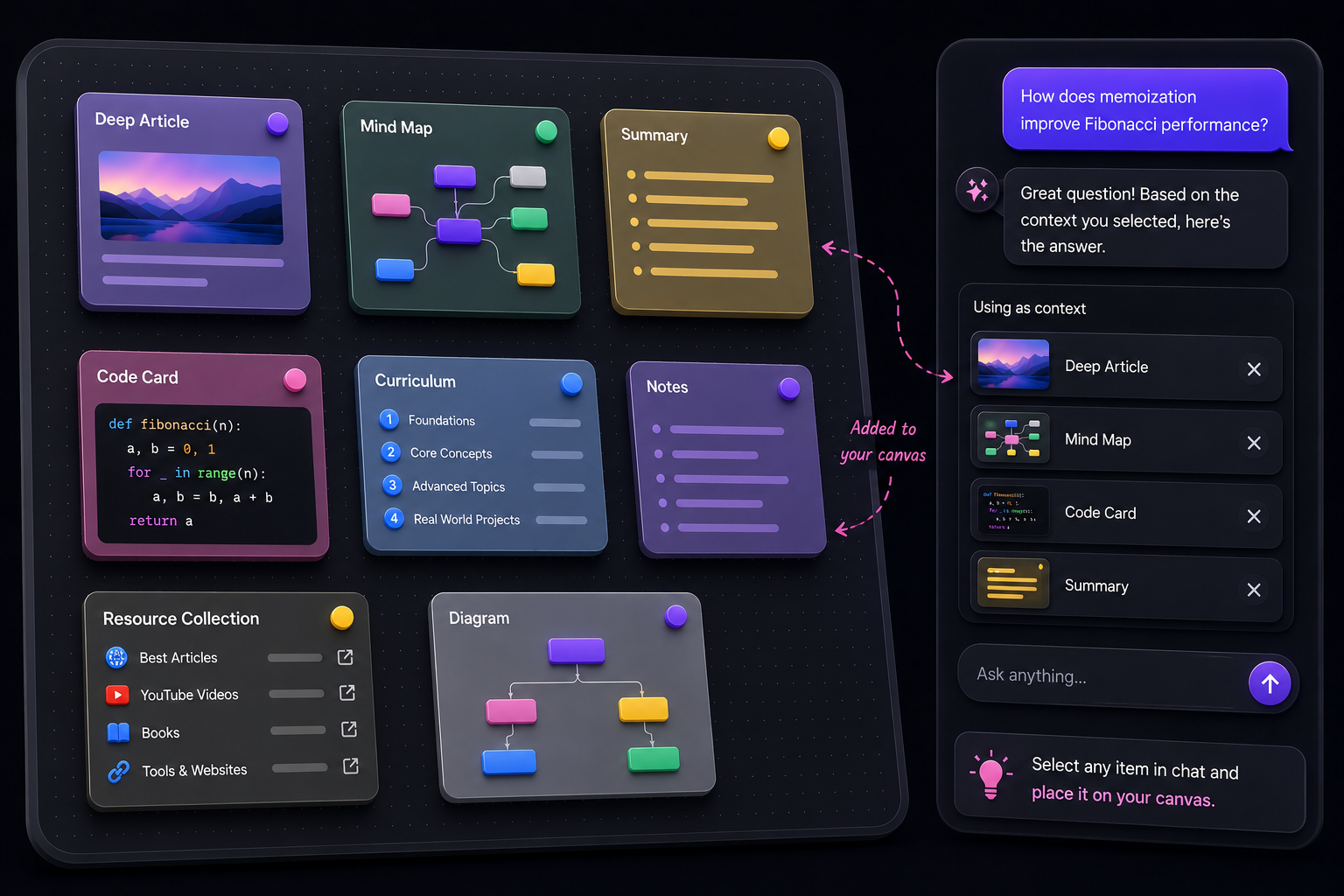
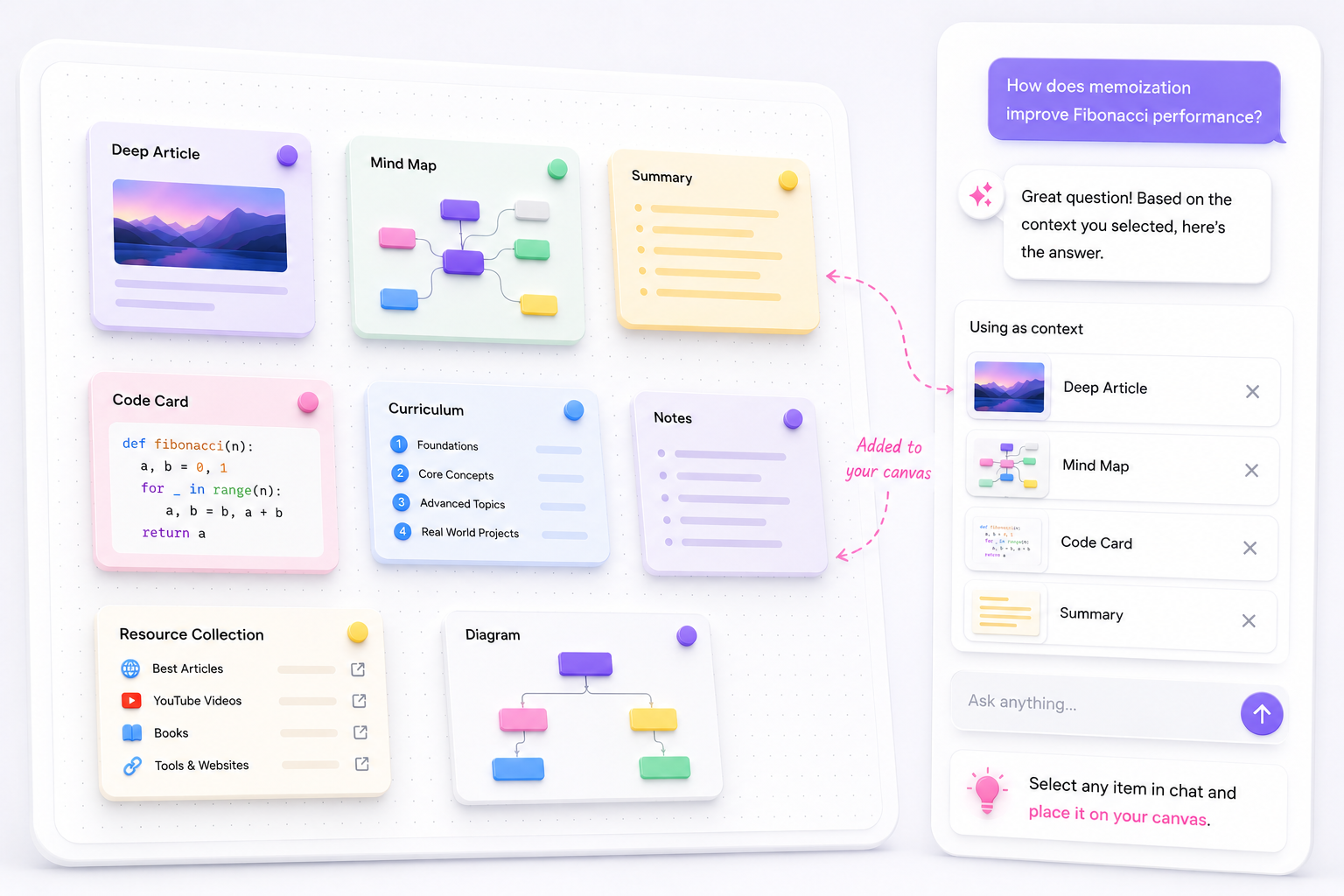
Create summaries, deep articles, diagrams, mind maps, curriculum, notes, code cards, and resource collections, then keep them ready for what comes next.
Everything has a place
Collect source material, capture your thinking, and create new learning artifacts—all in one connected workspace.
Ask questions grounded in uploaded documents.

Learn from transcripts and video explanations.

Keep useful articles and websites connected.

Save reading recommendations and references.

Keep people and experts worth learning from nearby.

Capture ideas, reminders, and selected chat passages.

Read summaries, curriculum, and deep explanations.

Keep visual references alongside the ideas they support.

Preserve reusable code directly from chat.

Visualize systems, processes, and relationships.

Explore a topic through expandable branches.
DocTree does not directly import a RemNote knowledge base. Bring the original learning material you want to explore into a new visual workspace.
Gather the PDFs, text or Markdown notes, articles, videos, and links behind the subject you studied in RemNote.
Start a canvas for the subject, add compatible sources, and arrange them around the concepts you want to understand.
Ask a grounded question and keep useful summaries, diagrams, articles, notes, or curriculum on the canvas for the next step.
Supported source types
No. DocTree does not currently provide RemNote-style flashcards, spaced-repetition scheduling, or an exam scheduler. It is an alternative for learners who prioritize source-grounded exploration, visual organization, and reusable knowledge artifacts.
DocTree gives each subject a freeform canvas where compatible sources, questions, answers, summaries, articles, diagrams, mind maps, curriculum, notes, code, and resources can stay connected and support later exploration.
Choose RemNote when native flashcards, spaced repetition, exam scheduling, linked notes, offline access, or collaboration are central to your study workflow.
Yes. RemNote can handle notes and scheduled recall, while DocTree can help you explore the underlying sources, map relationships, and create visual or long-form learning artifacts.
No direct RemNote knowledge-base importer is currently offered. Add compatible original source material such as PDFs, text or Markdown files, articles, and YouTube links to a DocTree canvas instead.
Yes. Compatible documents and article URLs can be extracted, embedded, and retrieved when you explicitly select them as context for a grounded question.
Yes. DocTree chat can answer ordinary questions or use explicitly selected compatible canvas items as context. Choose beginner, familiar, or expert depth, then keep useful explanations and artifacts on the canvas for later learning.
Yes. DocTree is free to start, so you can create a canvas, add compatible sources, and experience the learning workflow before choosing a paid plan.
Choose the plan that fits your study flow. Upgrade, downgrade, or cancel anytime.
For personal projects and experiments
No card required
Includes
For active learners building deeper knowledge trees.
$119.88/year, $36 less than monthly
Everything in Hobby, plus
For heavy learners, creators, and daily research workflows.
$239.88/year, $60 less than monthly
Everything in Pro, plus
Bring the sources you trust, see how their ideas connect, and keep every useful answer ready for the next question.
Free to start · No card required · Keep your sources and artifacts together


