

Ask questions grounded in uploaded documents.
DocTree vs Obsidian
Keep the visual thinking you value while adding an integrated tutor. Select trusted sources, ask grounded questions, and turn useful explanations into connected artifacts you can keep exploring.
Both products help ideas stay connected, but they begin from different assumptions about how knowledge work should happen.
Obsidian stores Markdown notes in local vaults and supports links, backlinks, Graph view, Canvas, themes, and a broad plugin ecosystem.
DocTree centers an integrated learning loop: collect sources, select context, ask or transform, place the result on the canvas, and reuse it for deeper exploration.
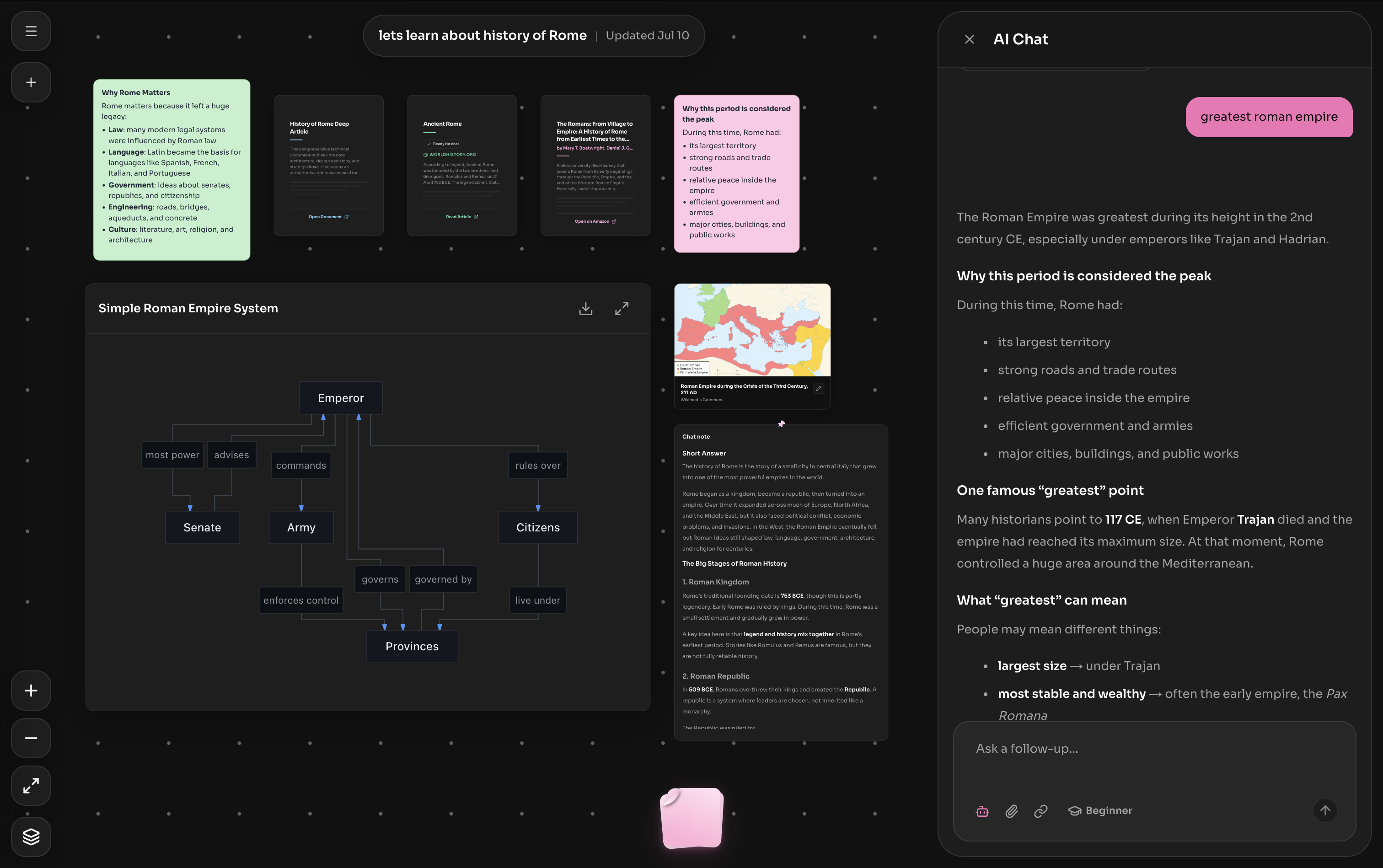
Choose Obsidian for a customizable local vault. Choose DocTree for guided, source-grounded learning with reusable AI artifacts.
Obsidian Local Knowledge Vault | DocTree Agentic Learning Workspace | |
|---|---|---|
| Own notes as local Markdown files | IncludedStores Markdown notes as ordinary files in a local vault | Not includedUses a hosted canvas workspace rather than a local Markdown vault |
| Work offline | IncludedKeeps a local vault available on the device without a network connection | Not includedRequires the online application for AI, retrieval, and workspace features |
| Customize with plugins, themes, and CSS | IncludedSupports core plugins, community plugins, themes, and CSS snippets | Not includedProvides an integrated product workflow instead of a user-assembled plugin stack |
| Link notes and inspect relationships | IncludedOffers internal links, backlinks, and global or local Graph views | IncludedConnects and arranges mixed sources and artifacts directly on each canvas |
| Arrange knowledge on an infinite canvas | IncludedCanvas arranges notes, media, attachments, and web pages in open JSON Canvas files | IncludedCanvas combines sources, chat context, and generated learning artifacts |
| Select the exact context for a question | Not includedCan support custom AI workflows through chosen plugins and configuration | IncludedSelected compatible canvas items explicitly establish chat context |
| Retrieve evidence from selected sources | Not includedSearch and retrieval behavior depends on the tools and plugins the user configures | IncludedRetrieves relevant passages from selected compatible documents, articles, videos, notes, and artifacts |
| Adapt explanations to the learner | Not includedDoes not prescribe a built-in beginner, familiar, or expert tutoring flow | IncludedAdapts vocabulary, pacing, examples, and depth to the chosen level |
| Create structured learning artifacts | IncludedSupports user-authored notes and plugin-defined creation workflows | IncludedCreates summaries, articles, diagrams, mind maps, curricula, notes, code, and resource collections |
| Reuse generated work as context | IncludedLinked notes remain available throughout the local vault | IncludedKeeps compatible generated artifacts selectable for later questions and transformations |
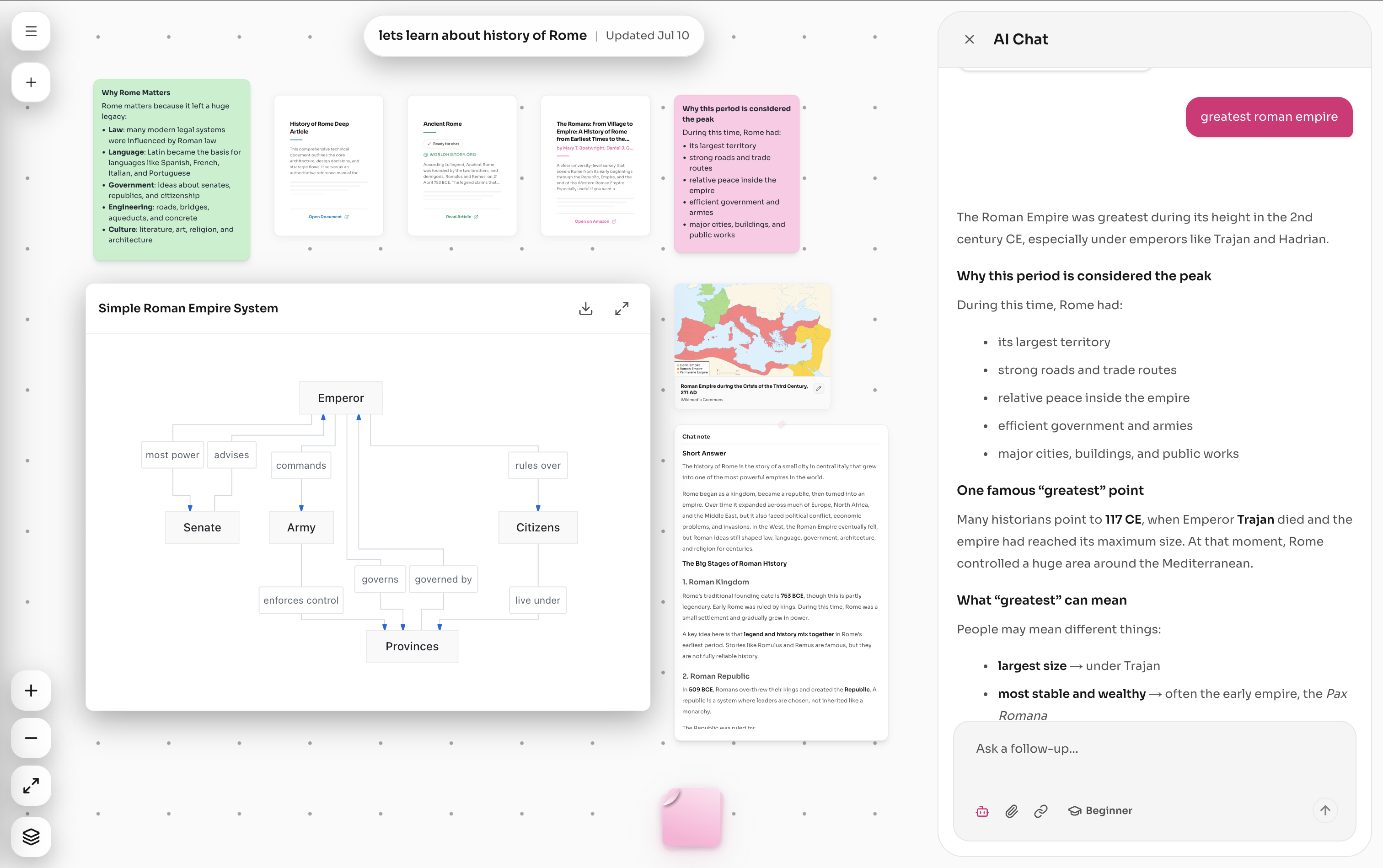
Watch DocTree turn a topic into an explorable curriculum, keep it beside the supporting sources, and make useful results available for the next question.
Create summaries, diagrams, mind maps, and notes from the topic or sources you are exploring.
Keep useful outputs beside the exact sources and canvas items that shaped them.
Move between sources, notes, and generated artifacts without rebuilding your context.
DocTree Advantage
DocTree retrieves relevant passages from compatible sources and uses them when you explicitly select those items for a question.
DocTree Advantage
Select the sources or artifacts that matter and ask DocTree to explain, compare, summarize, transform, or expand them.
DocTree Advantage
Keep compatible AI outputs on the canvas, connect them to the topic, and select them as context when you continue learning.
The right choice depends on whether you want maximum control over a local note system or an integrated environment for learning from sources.
Simple verdict
Choose Obsidian for a local, customizable knowledge vault. Choose DocTree for source-grounded learning on a visual canvas.
Obsidian
DocTree
Traditional flashcards
Source-grounded learning workspace
Add compatible PDFs, text documents, articles, YouTube videos, links, and notes to one canvas. Keep the evidence behind your learning close at hand.

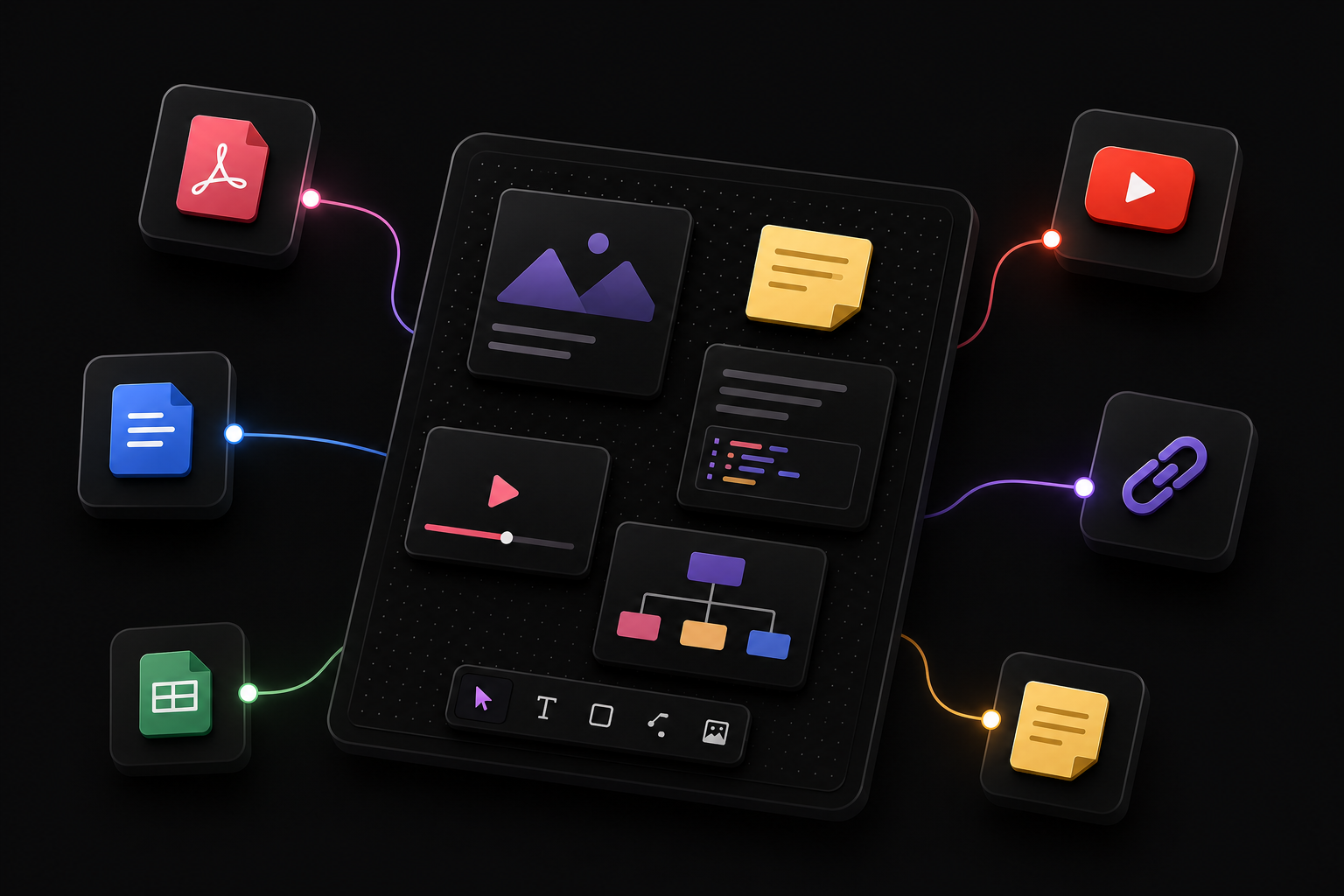
Select the exact compatible sources or artifacts you want to discuss, then ask DocTree to explain, compare, summarize, transform, or expand them.
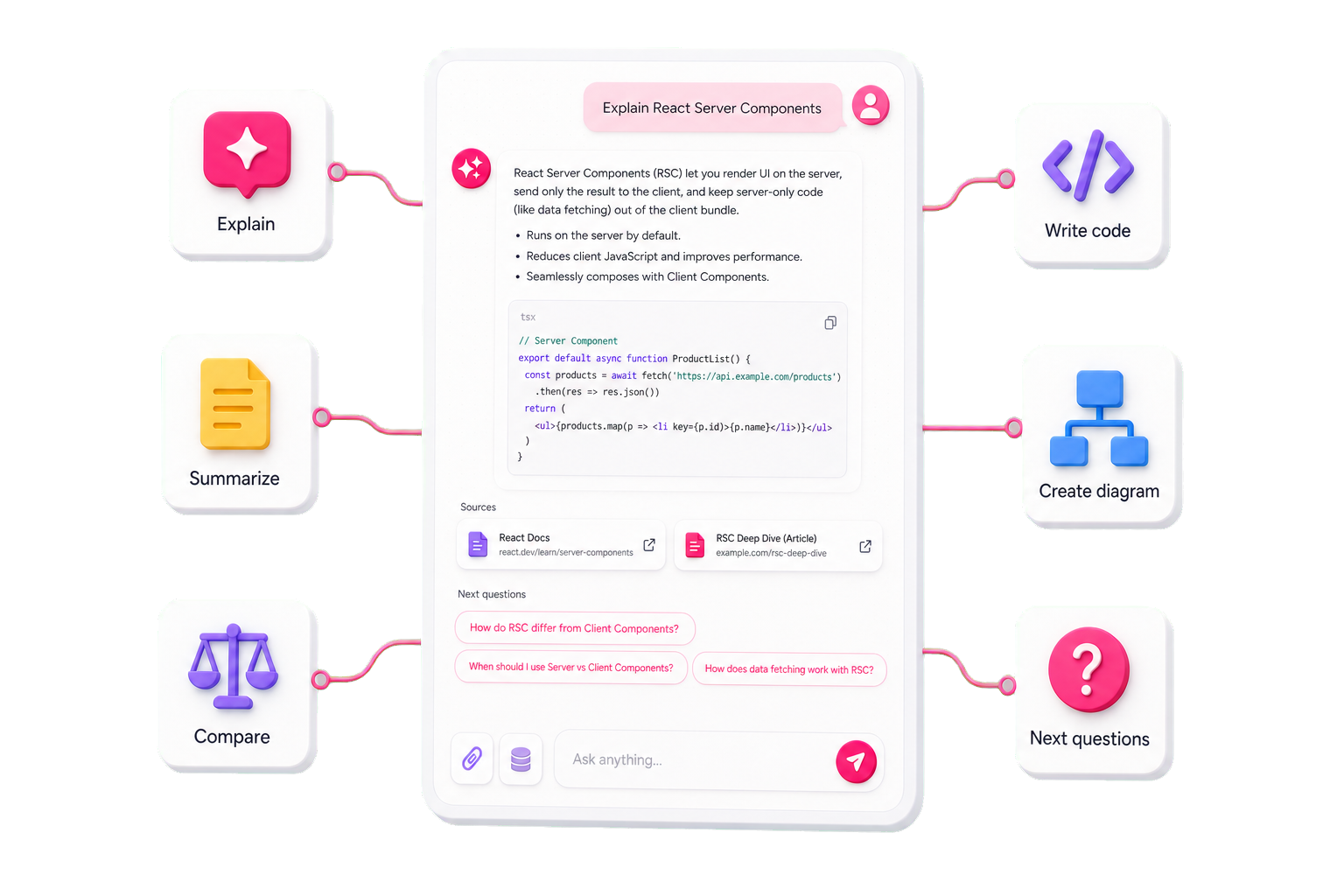
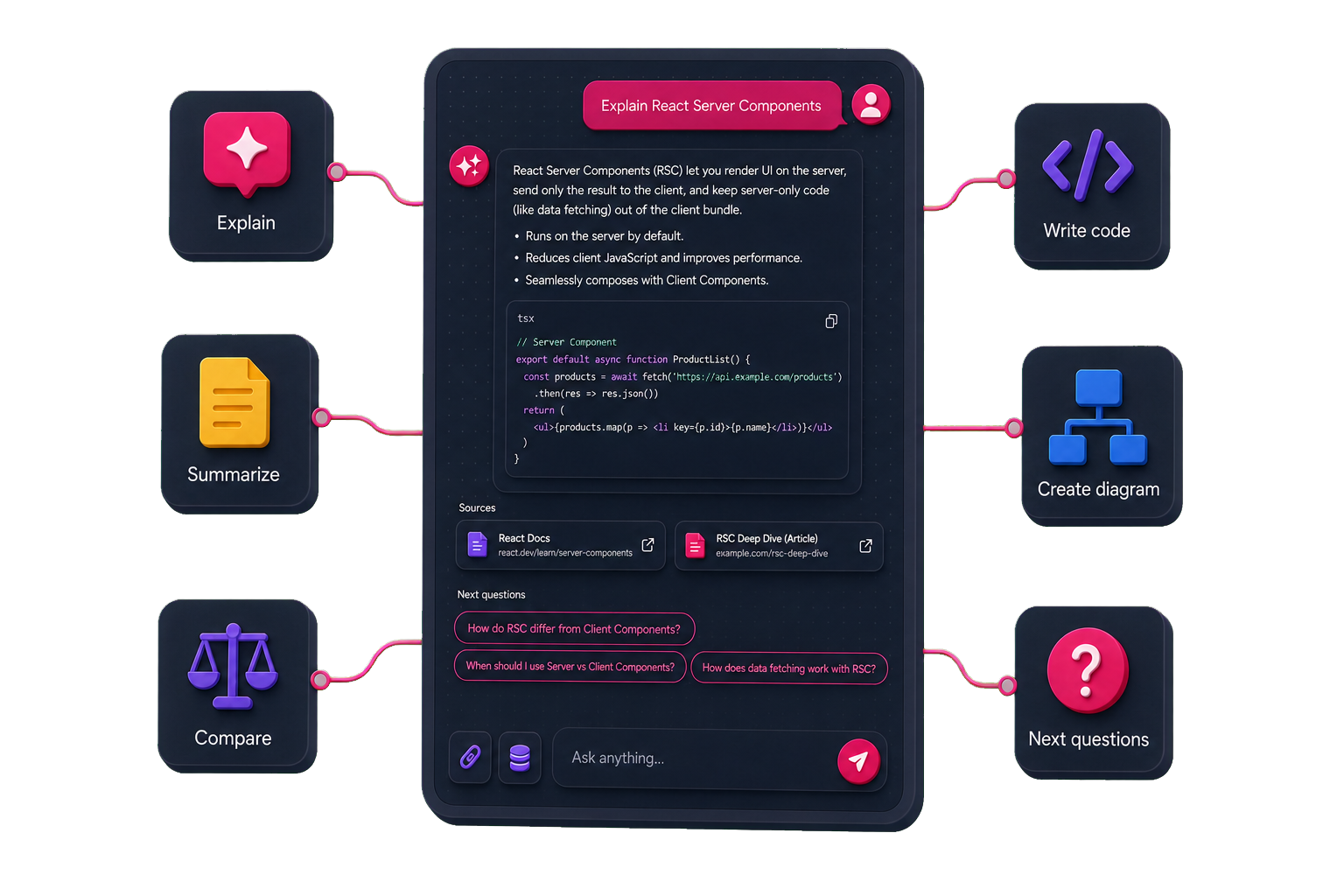
Create summaries, deep articles, diagrams, mind maps, curricula, notes, code cards, and resource collections, then keep them ready for what comes next.
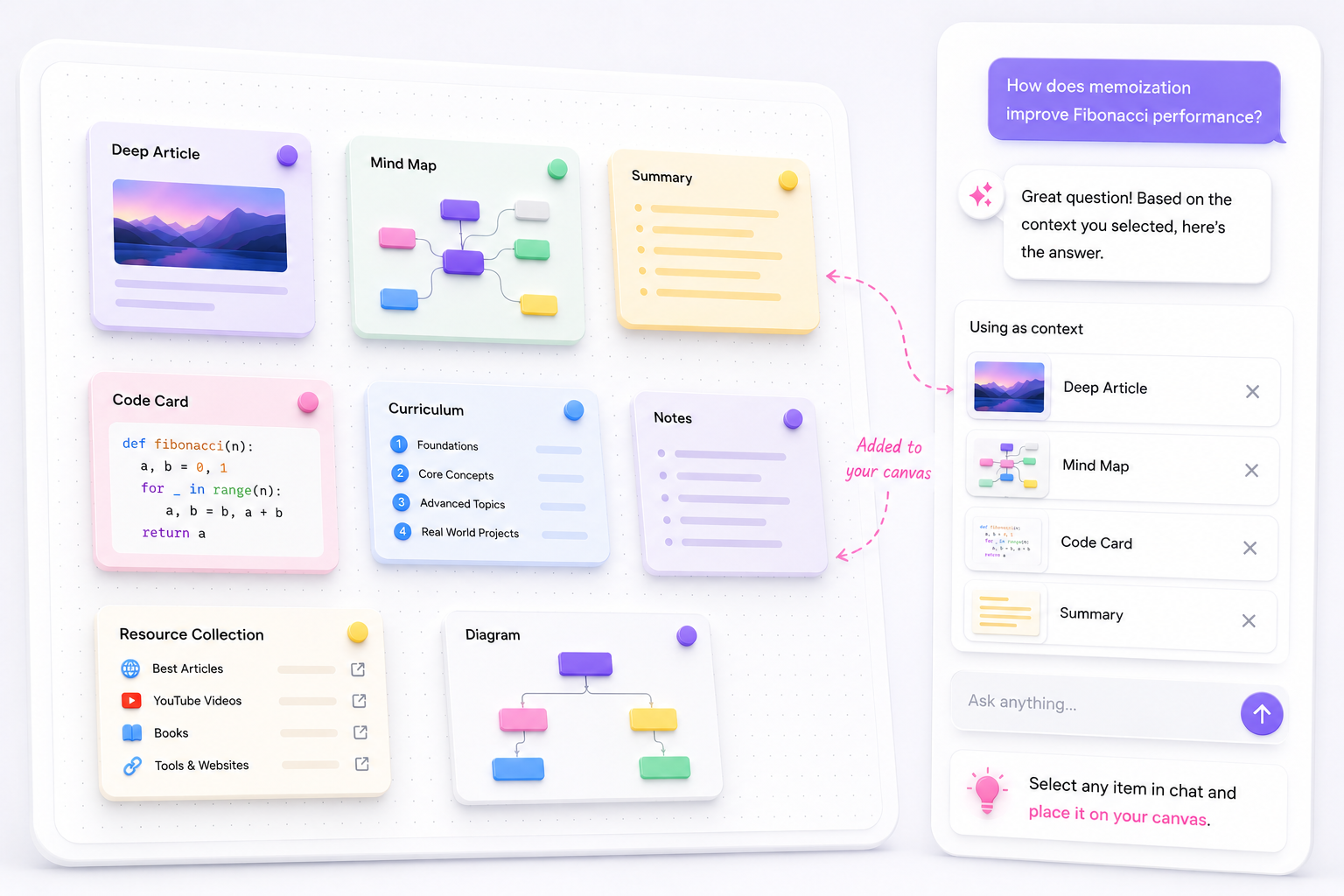
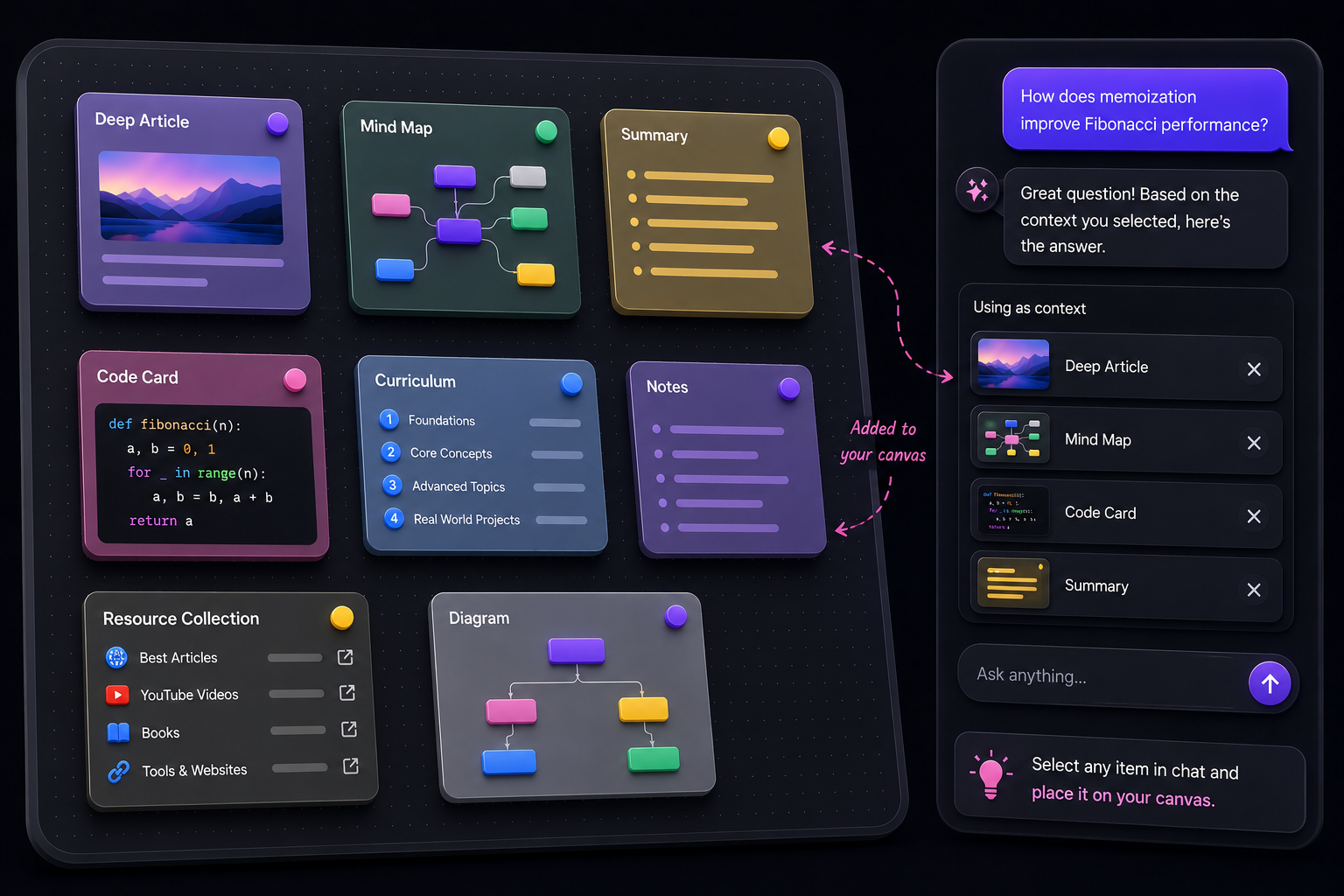
Everything has a place
Collect source material, capture your thinking, and create new learning artifacts—all in one connected workspace.
Ask questions grounded in uploaded documents.

Learn from transcripts and video explanations.

Keep useful articles and websites connected.

Save reading recommendations and references.

Keep people and experts worth learning from nearby.

Capture ideas, reminders, and selected chat passages.

Read summaries, curriculum, and deep explanations.

Keep visual references alongside the ideas they support.

Preserve reusable code directly from chat.

Visualize systems, processes, and relationships.

Explore a topic through expandable branches.
DocTree does not directly import a complete Obsidian vault, `.obsidian` configuration, plugins, graph state, or `.canvas` documents. Bring compatible notes and original sources into a focused visual learning workspace.
Select the Markdown or text notes, PDFs, articles, videos, and links that support the topic you want to understand.
Start a canvas for that subject, add compatible sources, and arrange them around the questions or concepts you want to explore.
Ask a grounded question and keep useful summaries, diagrams, articles, notes, or curricula on the canvas for the next step.
Supported source types
Not for every workflow. Obsidian is stronger when you prioritize local Markdown ownership, offline access, extensive customization, and community plugins. DocTree is an alternative for learners who prioritize integrated source retrieval, adaptive tutoring, and reusable visual AI artifacts.
DocTree combines a spatial canvas with a context-aware tutor. Select compatible sources or artifacts, ask at beginner, familiar, or expert depth, and keep generated summaries, articles, diagrams, mind maps, curricula, notes, code, and resources on the canvas.
Choose Obsidian when you want local Markdown files, offline access, backlinks, Graph view, open JSON Canvas files, and extensive control through plugins, themes, CSS, and sync choices.
Yes. Obsidian can remain your long-lived local knowledge vault, while DocTree can provide a focused space for learning from selected sources and developing reusable visual artifacts.
No complete-vault importer is currently offered. DocTree does not transfer `.obsidian` settings, plugins, graph state, or `.canvas` documents. Add compatible Markdown or text notes and the original sources for a focused topic instead.
Obsidian Canvas is an open-format infinite space for arranging notes, media, attachments, and web pages from a vault. DocTree's canvas coordinates selected source context, tutor conversations, and generated learning artifacts in one workflow.
Obsidian Graph view visualizes relationships created by links between vault notes. DocTree's canvas is a manually arranged workspace containing sources and artifacts that can be selected as context for later questions and transformations.
Obsidian can be extended through community plugins, including user-chosen AI workflows. DocTree differs by providing source retrieval, context selection, adaptive tutoring, and artifact creation as an integrated product experience.
Yes. Compatible documents, article URLs, and YouTube transcripts can be extracted, embedded, and retrieved when you explicitly select them as context for a grounded question.
Yes. DocTree is free to start, so you can create a canvas, add compatible sources, and experience the learning workflow before choosing a paid plan.
Choose the plan that fits your study flow. Upgrade, downgrade, or cancel anytime.
For personal projects and experiments
No card required
Includes
For active learners building deeper knowledge trees.
$119.88/year, $36 less than monthly
Everything in Hobby, plus
For heavy learners, creators, and daily research workflows.
$239.88/year, $60 less than monthly
Everything in Pro, plus
Start a DocTree canvas and turn selected notes, documents, articles, and videos into grounded explanations and reusable learning artifacts.
Free to start · No card required · Keep sources and learning artifacts together


